Here you’ll find all the frequently asked questions and answers we’ve compiled for you.
What is the difference between push and pull configuration in UAVs?
In a pull configuration, the propeller is mounted at the front. In a push configuration, it is positioned at the rear, which keeps the UAV nose free for sensors but increases demands on cooling and engine integration.
Why is push configuration used in ISR UAVs?
Push configuration is used in ISR UAVs because the front section remains clear for EO/IR cameras, radar or LiDAR systems. Sky Power engines support these platforms when propulsion, cooling and vibration behavior must be precisely integrated.
What are the advantages of pull configuration for UAV engines?
Pull configuration gives the propeller and engine cleaner airflow, which can improve efficiency and cooling. This supports stable operating conditions for Sky Power UAV engines in endurance-focused platforms.
How does propeller configuration affect UAV engine cooling?
Propeller configuration affects cooling airflow, heat accumulation and engine temperature distribution. Sky Power considers thermal management, exhaust routing and vibration behavior as part of the complete UAV propulsion system.
What is the difference between a carburetor and electronic fuel injection in UAV engines?
A diaphragm carburetor meters fuel mechanically and does not require sensors, control units or electronic actuators. Electronic fuel injection, also known as EFI, uses sensor data and map-based control to adjust the fuel-air mixture more precisely across different operating conditions. For UAV manufacturers, the main difference lies in system complexity, control precision, integration effort and mission flexibility.
When is a carburetor the right choice for a two-stroke UAV engine?
A carburetor can be the right choice when a UAV platform requires maximum robustness, simple integration, low system complexity and predictable operating conditions. This makes carburetor-based engines especially relevant for applications where ease of maintenance, reliability and straightforward commissioning are more important than advanced digital engine control.
When should UAV manufacturers choose electronic fuel injection?
Electronic fuel injection is particularly suitable for long-range UAVs, BVLOS missions, high-performance platforms, hybrid propulsion systems and applications with changing environmental conditions. EFI can improve fuel efficiency, combustion stability, altitude compensation, diagnostics and telemetry integration.
Why is fuel mixture preparation important for professional UAV applications?
Fuel mixture preparation directly influences combustion stability, specific fuel consumption, load response, thermal stress and engine service life. For UAV manufacturers and system integrators, choosing the right fuel metering system is therefore an important part of propulsion system design and can affect efficiency, reliability and mission performance.
Why do long-range drones still need combustion engines?
Long-range drones need combustion engines because liquid fuels provide significantly higher energy density than current battery systems. Sky Power UAV engines are designed for missions that require long flight times, extended range and reliable onboard power for sensors, communication systems and payloads.
What limits battery-powered UAVs in long-range operations?
Battery-powered UAVs are limited by battery weight, charging time, usable energy capacity and temperature sensitivity. For demanding BVLOS, ISR or surveillance missions, Sky Power combustion engines provide a practical alternative when endurance, payload capacity and operational independence are critical.
Are combustion engines better than batteries for UAV endurance?
For long-endurance UAV missions, combustion engines currently offer clear advantages over purely battery-electric systems. Sky Power develops UAV propulsion solutions that support longer operating times, fast refueling and stable performance in remote, cold or mission-critical environments.
Why are hybrid propulsion systems important for modern UAVs?
Hybrid UAV propulsion systems combine the endurance of combustion engines with the control benefits of electric drives. In these architectures, Sky Power engines can support long-range operation as a primary propulsion system, generator or range extender, depending on the UAV platform and mission profile.
What is the difference between a carburetor and electronic fuel injection in UAV engines?
A carburetor meters the fuel-air mixture mechanically. Electronic fuel injection uses sensor data and map-based control to adjust the mixture more precisely across changing operating conditions.
When is a carburetor suitable for two-stroke UAV engines?
A carburetor is suitable when robustness, simple integration, low system complexity and predictable mission profiles are key requirements.
When should UAV manufacturers choose electronic fuel injection?
Electronic fuel injection is suitable for long-range UAVs, BVLOS missions, high-performance platforms, hybrid propulsion systems and changing environmental conditions.
Why should UAV propulsion units be considered early in platform development?
UAV propulsion units directly influence mission reliability, delivery timelines, operating costs and customer trust. If the propulsion system is selected too late or only based on cost, it can create delays, technical risks and long-term damage to the UAV manufacturer’s reputation.
What risks can result from choosing an insufficient UAV engine?
An insufficient UAV engine can lead to mission failures, delayed deliveries, contractual penalties, higher development costs and loss of confidence among end customers. In professional UAV programs, propulsion reliability is therefore a business-critical factor.
Why is real-life operating experience important for UAV propulsion systems?
Real-life operating experience shows how a propulsion system performs under practical mission conditions, not only in laboratory tests or marketing materials. This is important for ISR, maritime surveillance, tactical and other mission-critical UAV applications.
What should UAV manufacturers consider when selecting a propulsion system?
UAV manufacturers should evaluate reliability, endurance testing, fuel efficiency, TBO, maintenance cycles, integration requirements and proven operation in real UAV platforms. The right propulsion system supports long-term program security instead of short-term cost savings.
Which propulsion unit powers the Nimkii 42-S UAS?
The Nimkii 42-S is powered by the Sky Power SP-55 FI TS ROS. It is a single-cylinder internal combustion engine with 55 cm³ displacement, 3.0 kW output at 7,000 rpm, dual ignition and fuel injection.
Why is the SP-55 FI TS ROS suitable for long-range UAS applications?
The SP-55 FI TS ROS combines low weight, compact design, fuel injection and dual ignition. These features support efficient operation, reliable combustion and stable performance in unmanned aerial vehicles used for long-range missions.
What technical requirements does the Nimkii 42-S place on the propulsion system?
The Nimkii 42-S is designed for long-range cargo and monitoring missions, including operation in harsh northern Canadian conditions. Its propulsion system must support endurance, payload transport, reliability, cold-weather operation and safe performance across remote areas.
Which applications can benefit from a UAS platform like the Nimkii 42-S?
A platform like the Nimkii 42-S can support infrastructure monitoring, forest fire observation, wildlife management and cargo delivery to remote regions. Its long-range capability and cargo capacity make it relevant for areas with limited transport infrastructure.
Why is engine break-in important for UAV propulsion systems?
Engine break-in allows internal engine parts, especially piston rings and cylinder walls, to adjust to each other. This improves compression, supports a more reliable combustion cycle and helps the engine reach its intended performance level.
How does engine break-in affect fuel consumption?
A properly broken-in engine can operate more efficiently because piston rings and cylinder walls seal more effectively. Sky Power’s internal analysis showed a measurable difference in fuel consumption between a broken-in engine and one that had not completed the break-in process.
What happens if the engine break-in phase is not completed?
If the break-in phase is not completed, engine performance, fuel efficiency and service life can be compromised. The engine may also fail to reach optimal peak RPM and thrust values.
Why should UAV manufacturers use a professional engine break-in service?
A professional break-in service ensures that the process is performed under controlled conditions. This allows UAV manufacturers to receive an engine that is ready for integration and helps reduce effort during platform assembly and testing.
What is the purpose of the SP-180 SRE APU demonstrator?
The SP-180 SRE APU demonstrator is a mobile test and evaluation system for independent power supply. It allows electrical devices to operate while the main engine remains switched off.
Why is a Wankel engine suitable for APU applications?
A Wankel engine offers a compact design, low weight, smooth operation, low vibration and consistent power output. These characteristics are useful when space, weight and reliable power generation are critical.
Which components are integrated into the SP-180 SRE APU demonstrator?
The system includes the SP-180 SRE hybrid Wankel engine, ECU, starter, 12 kW alternator, EFI, fuel pump, exhaust and silencer, electrical controls and thermal management with oil and cooling circuits.
How can an APU reduce fuel consumption and maintenance effort?
An APU can power electrical systems while the main engine is switched off. This can reduce idling time, fuel consumption, emissions, wear on the main engine and maintenance costs.
Why are payload and range important for cargo drone propulsion?
Payload and range directly influence the required propulsion power, energy demand and overall aircraft weight. The higher the payload and the longer the required distance, the more carefully the propulsion and energy system must be dimensioned.
When can battery-electric propulsion be suitable for cargo UAVs?
Battery-electric propulsion can be suitable for shorter missions with comparatively low payloads. In these applications, electric propulsion can offer significant advantages, especially when flight duration and energy demand remain within practical limits.
When do fuel-based propulsion concepts become relevant?
Fuel-based propulsion concepts can become relevant when cargo UAVs require longer flight durations, greater range or higher payload capacity. As mission requirements increase, the ratio between stored energy and system weight becomes a decisive design factor.
Why can hybrid propulsion be useful for VTOL cargo drones?
VTOL cargo drones require high peak power during vertical take-off and landing, while cruise flight often needs less continuous power. Hybrid architectures can combine battery power for short-term peak loads with fuel-based continuous power generation for longer missions.
What is the difference between Two-Stroke and Wankel Engines for UAVs?
Two-Stroke and Wankel Engines differ mainly in their architecture, operating principle, vibration behavior, packaging, and maintenance characteristics. The whitepaper explains how these differences affect UAV integration and mission performance.
Which engine is better for UAVs: Two-Stroke or Wankel?
There is no universal answer. The right engine depends on mission profile, payload requirements, endurance targets, integration concept, and operational strategy.
Why are Wankel Engines used in UAVs?
Wankel Engines can be attractive for UAV applications where compact design and smooth running behavior are important, especially for vibration-sensitive payloads.
Why are Two-Stroke engines used in UAV propulsion?
Two-Stroke engines are widely used in UAV propulsion because they can offer a strong combination of robustness, power density, scalability, and practical maintainability.
How does engine choice influence UAV performance?
The propulsion system can affect endurance, payload stability, vibration levels, maintenance planning, lifecycle costs, and overall platform design. The whitepaper examines these factors in detail.
What types of UAV engines does Sky Power offer?
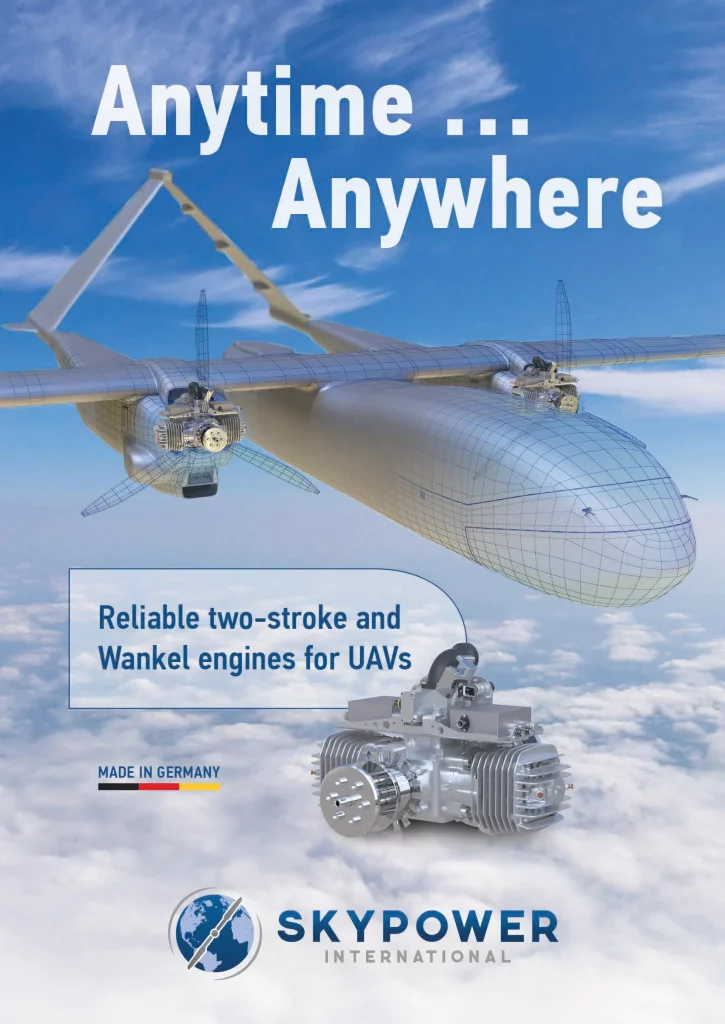
Sky Power offers 2-stroke boxer engines and Wankel engines for professional UAV applications. The engines can be configured for gas or heavy fuel use and integrated into direct propulsion, hybrid propulsion, range extender or generator concepts.
Which UAV engine is suitable for long-endurance missions?
Long-endurance UAV missions require an engine with efficient fuel consumption, reliable thermal behavior, suitable power-to-weight ratio and stable operation over extended flight times. The right engine depends on the aircraft type, payload, fuel concept and mission profile.
When is a 2-stroke UAV engine the right choice?
A 2-stroke UAV engine is suitable when high power density, robust performance and scalable configurations are required. This can be relevant for fixed-wing UAVs, VTOL platforms and other professional unmanned aircraft.
When is a Wankel UAV engine the right choice?
A Wankel UAV engine can be suitable when compact installation, smooth running behavior and reduced vibration are important. These characteristics are especially relevant for UAVs with limited installation space or vibration-sensitive payloads.
Can UAV engines be used in hybrid propulsion systems?
Yes. UAV engines can be integrated into hybrid propulsion systems, range extender concepts or generator operation. This allows the combustion engine to support longer flight times, onboard electrical power or electric propulsion architectures.
Why are propulsion systems important for agricultural UAVs?
The propulsion system directly influences payload capacity, flight time, operational reliability and economic efficiency. This is especially important when agricultural UAVs are used for spraying, surveying, transport or BVLOS operations.
Why should the mission profile guide engine selection?
Different agricultural UAV missions create different power requirements. Surveying UAVs often need stable endurance, spraying drones must handle changing payloads and transport UAVs require high continuous power and reserves during takeoff and climb.
When can combustion engines be useful in agricultural UAVs?
Combustion engines can be useful when agricultural UAVs require longer flight times, higher payloads, short refueling times or reliable operation across large areas and changing environmental conditions.