
Propulsion systems in unmanned aerial vehicles (UAVs) must be highly reliable, as the motors are mission-critical components. A proof of reliability is therefore important and is required by every engine manufacturer. Sky Power GmbH therefore tested its SP-110 FI TS GEN and SP-210 FI TS GEN to demonstrate its endurance and reliability with a highly loaded running profile in accordance with FAR33.
During the test, the engines are operated on Sky Power’s stationary engine test bench under a predefined load and operating temperature. Both are monitored by personnel regarding changes in performance and component failures. During operation, the engines are controlled to various speeds
which are representative of the likely flight conditions. After a test period of 150 hours and a further 30 to 40 run-in hours before the test, both engines successfully completed the tests. Before the start, various objectives were defined that were to be achieved with the endurance test. These included load limits and endurance data. At the same time, the airworthiness of the engine was checked and documented by Sky Power qualifying the reliability according to defined FAA standards. Data was also collected to further evaluate the product’s operating limits, maintenance schedules and hourly operating costs in relation to the product life cycle.
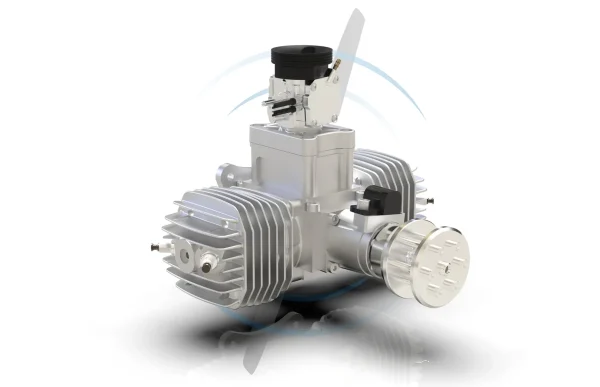
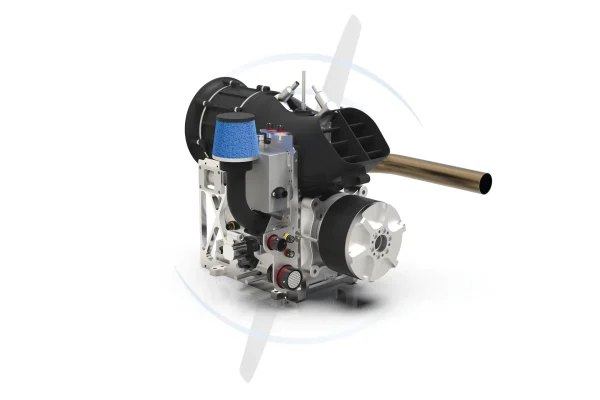
The 2-stroke Boxer engine SP-110 FI TS GEN with 110ccm is a common engine system on UAV programs from 45-65kg MTOW. The engine is equipped with dual spark plugs per cylinder, the crankcase is CNC machined and the cylinders are casted aluminum. The second engine, the 2-stroke Boxer engine SP-210 FI TS GEN with 210ccm is positioned in the 60~100kg UAS tier. Current operational conditions include maritime and desert environments with 1000s hours achieved to date. Designed and built from the same proven core architecture as other Boxer engines in Sky Power portfolio, these engine systems offer power density and reliability in all operational scenarios.
The test setup was carried out on Sky Power GmbH’s stationary engine test bench. Testing was carried out according to a specified maximum temperature and speed profile for approx. 8 hours per day until a prescribed test duration of 150 hours was reached. In addition to the component hours, engine telemetry, ambient conditions and fuel consumption, all test results were documented, evaluated and summarized in a test protocol. At the end of the daily test cycles, the engines were subjected to an inspection based on a checklist in order to detect changes at an early stage, document them and rectify them if necessary. After 150 hours, the engines were removed from the test bench and subjected to a full test.
In 2021, Sky Power has already successfully passed the FAR33 test with the SP-55 TS carburetor engine. The SP-55 TS is an air-cooled, 2-stroke, single-cylinder engine, with a displacement of 55 cc (10.37 cu in). The engine uses Sky Power electronic ignition and a Walbro HDA6A carburetor for fuel delivery. The fuel used in the test run was unleaded gasoline, in four different versions, at a 50:1 oil premix ratio. Engine power is 3.07 kW (4.18 hp) at 6500 rpm. The engine is designed for a direct-drive propeller in a thrust or tug configuration.
Sky Power will showcase its powerful propulsion systems at this year’s Xponential from April 22-25, 2024, San Diego Convention Center, San Diego, CA, booth number 4037.